
Today I am very glad to tell you about a big accomplishment the colleges from Nordic seed and Agrologica achieved. After years of work a new wheat mapping population for common bunt resistance was been bread. Let me tell you a bit about the background before letting Jihad Orabi, Anders Borgen, Dennis Christensen, Lotte Olesen, Pernille Bjarup and Ahmed Jahoor tell you about their success.
After the bunt and smut workshop in Tulln 2023 the idea of a new mapping population was born. In one of Anders Borgens fields in Denmark the crossings, based on Dennis Christensen´s selection of parents with high polymorphic marker contrasts, were performed. The F1 seeds from the 8 crosses were send to Nordic Seed were in total 4 generations were propagated. From the F5 generation a spike per cross were send back to Anders for multiplication. The next step is a field trial to see how these crosses perform in the wild.
The following part gives you a more detailed insight on what was done (Text rights: Jihad Orabi, Anders Borgen, Dennis Christensen, Lotte Olesen, Pernille Bjarup and Ahmed Jahoor):
To facilitate the mapping of genetic loci associated with resistance to common bunt (caused by Tilletia caries and T. foetida), eight biparental wheat mapping populations were developed (see Table 1). The crossings are designed for high marker contrast over the already mapped intervals. The F₁ seeds for each cross were produced by Anders Borgen, and subsequent generations were cultivated in Nordic Seed greenhouse using a speed breeding approach. Using this method, we successfully developed approximately 200 F₅ recombinant inbred lines (RILs) per population.
These F₅ lines will be sent to Agrologica for multiplication and phenotypic evaluation under controlled bunt inoculation conditions. The resulting phenotypic data will be integrated with genotypic information of the sample F5 lies to examine the crossovers in the intervals. As well as to perform genome-wide association studies (GWAS), which are aimed at improving the resolution of common bunt resistance gene mapping. This collaborative effort is expected to refine the location of known genes and potentially reveal novel loci that contribute to resistance.
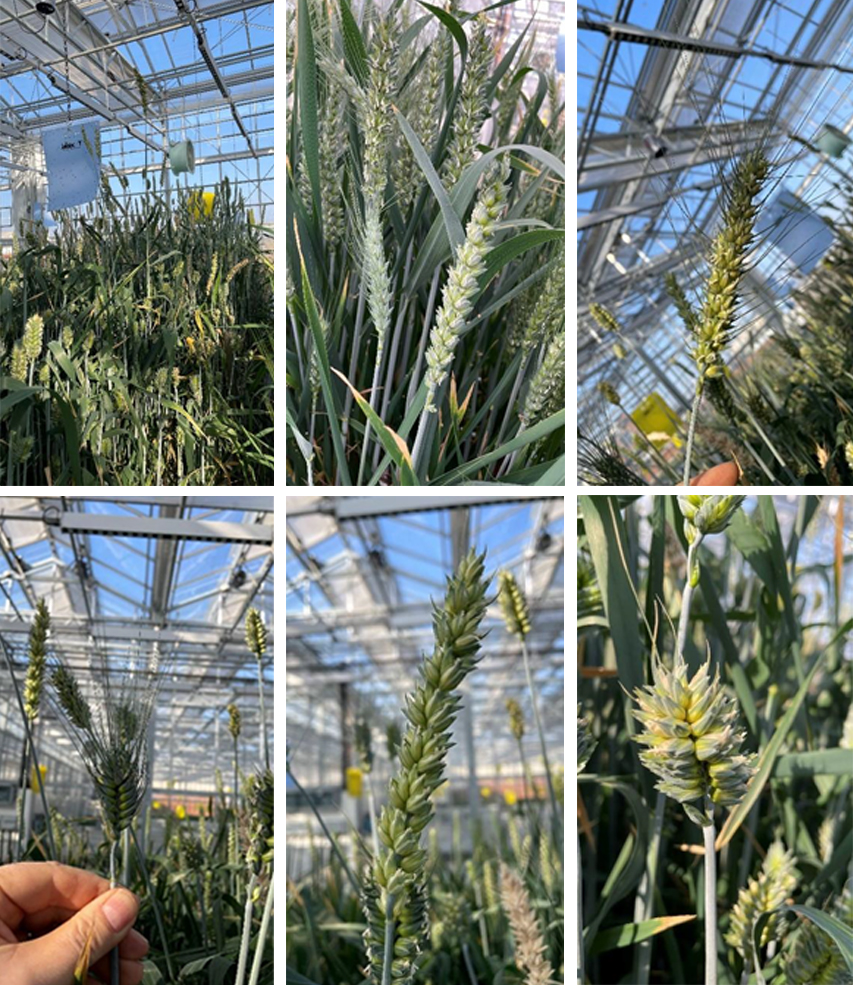
It is worth noting that the developed populations exhibit a wide range of morphological variations, particularly in terms of spike shape and size. This reflects the genetic diversity among the parental lines (see pictures of the post taken by Jihad Orabi).
Table 1: Overview of the eight wheat-mapping populations developed for common bunt resistance.
| Cross Number | Parents | Type | Remark |
| 1. | Tillexus*Hallfreda | Winter*Winter | Polymorphic in the Bt10 interval (and possible recombinations near Bt9) |
| 2. | Pi554097*Thule-III | Winter*Winter | Polymorphic in the Bt13 interval (and possible to study also Bt2) |
| 3. | Pi554101*S.Th.Cia-2 | Winter*Winter | Polymorphic in the Bt13 interval (and to study Bt1) |
| 4. | S.Th.Cia-4*OD-19 | Spring*Spring | Polymorphic in the Bt13 interval |
| 5. | S.Th.Cia-3*CCP-7 | Spring*Spring | Polymorphic in the Bt13 interval (and possible recombinations near Bt7) |
| 6. | Tommi*Tillexus | Winter*Winter | Polymorphic in the Bt5 interval (and possible recombinations near Bt10) |
| 7. | Østby*Tommi | Spring*Winter | Polymorphic in the Bt5 interval |
| 14 | Erythrospermum 5221*Mirakel | Winter*Spring | Made to study the Erythrospermum-resistance |